
Although this may be a slight deviation from technical translation, today I would like to share something more personal: my side project, Kanji Passport, a free kanji learning app deployed on Telegram.
Japanese kanji has been both my passion and my challenge for a long time. Anyone who has studied Japanese knows that kanji are not just characters to memorize. They are a complex system of meanings, readings, components, radicals, visual patterns, and associations. They can be beautiful, logical, confusing, frustrating, and rewarding — often all at the same time.
For a long time, I wanted to turn my interest in kanji into something useful and practical. Finally, with the help of modern tools, including Codex, and free Japanese language learning resources available on the internet, I decided to create a simple app that would make kanji learning more accessible.
That is how Kanji Passport was born.
What Is Kanji Passport?
Kanji Passport is a Telegram-based app that helps users explore and review Japanese kanji directly inside Telegram.
There are already many powerful kanji learning apps available online. However, I wanted to create something specifically for Telegram users — something lightweight, convenient, and always available at your fingertips.
The idea is simple: open the bot, choose a kanji, check its meaning, readings, radical, examples, stroke order, and memory hint — all in one place.
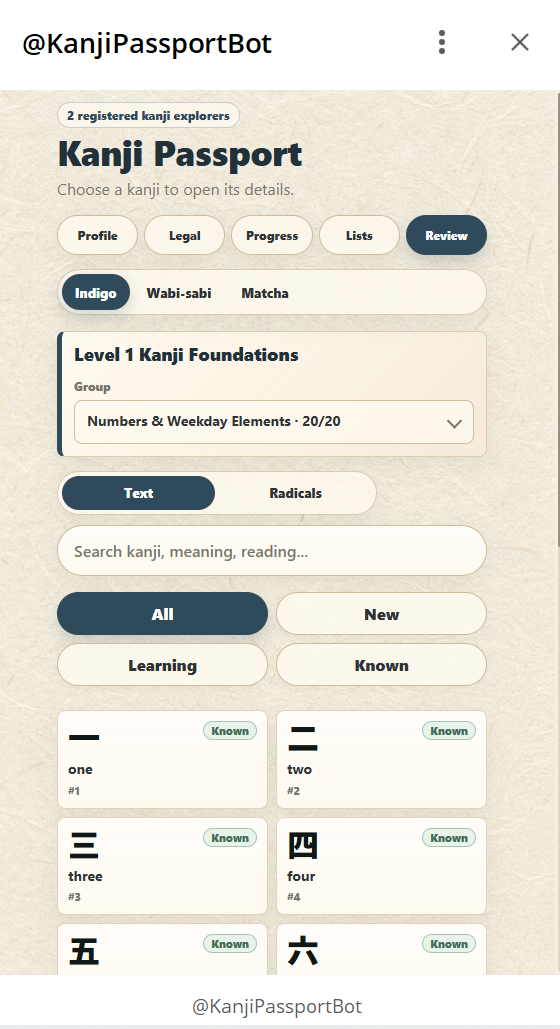
Kanji Passport currently covers 2,139 kanji.
They are divided into levels and thematic groups within each level. The structure follows, to some extent, the order in which kanji are taught in the Japanese school system, but the app does not simply reproduce a school-grade list.
Instead, the app presents kanji as a journey.
Each level works like a stage of progress. Within each level, kanji are grouped by themes.
This thematic structure helps learners see kanji not as isolated symbols, but as connected elements of meaning. Instead of memorizing random characters one by one, users can study related kanji together and gradually build a mental map of how meanings, radicals, and components are linked.
Kanji Cards with Readings, Radicals, and Stroke Order
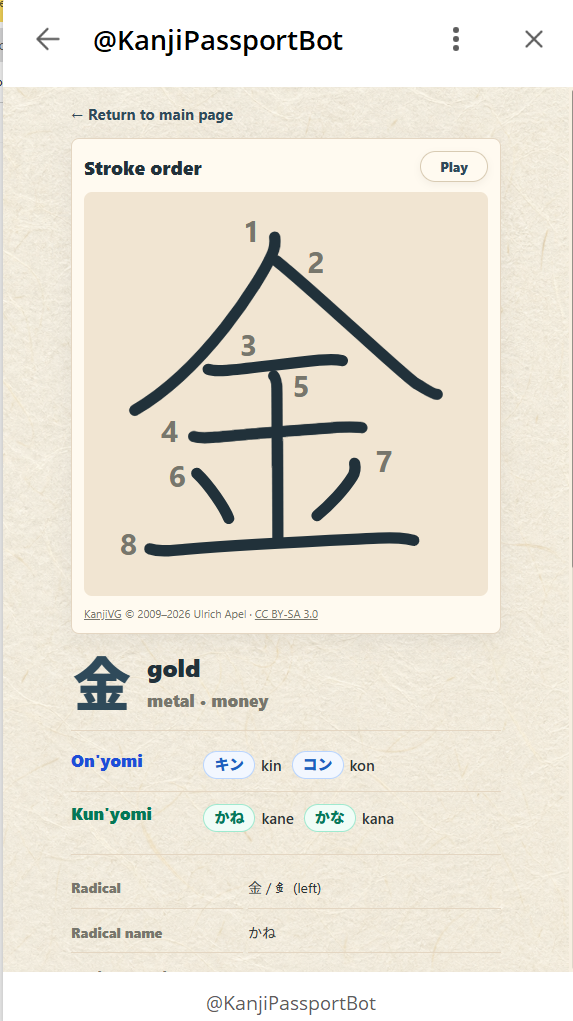
Each kanji has its own card. The card includes the character, its basic meaning, on’yomi and kun’yomi readings, radical information, examples, and stroke order.
Stroke order is especially useful for beginners because kanji are not only read — they are also written. Seeing how a character is built stroke by stroke helps users understand its internal structure and remember it more naturally.
Personalized Study Lists
One of the key features of Kanji Passport is the ability to create personalized study lists.
Users can explore kanji not only by level or thematic group, but also by:
- main radical;
- reading;
- meaning;
- study status.
This makes the app useful for different types of learners. A beginner can move through the levels step by step. A more advanced learner can create a focused list, for example, all kanji with a certain radical or all kanji connected with a particular meaning.
Memory Hints and Mnemonics
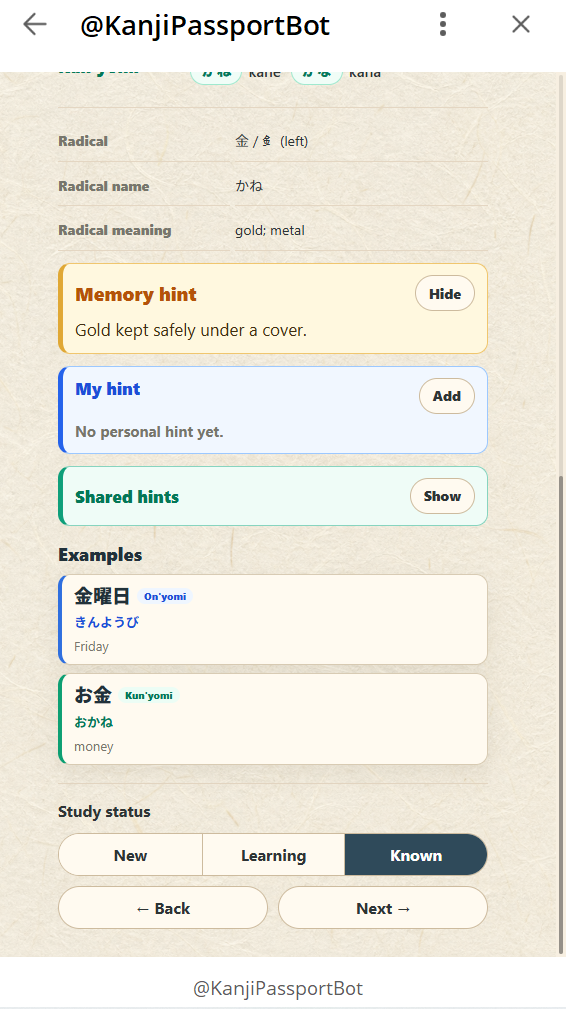
Each kanji card includes a Memory hint — a short mnemonic that helps the learner remember the kanji, its components, or its visual structure.
I believe mnemonics are one of the most helpful tools for kanji learning. A complicated character becomes easier to remember when it is broken into smaller parts and connected with a simple image or story.
Kanji Passport also allows users to create their own personal memory hints.
The app also has shared hints, which opens the door to a more creative and interactive way of learning. Users can compare memory hints and even compete in writing better mnemonics for kanji.
A Supplement to Your Kanji Journey
Kanji Passport is not meant to replace textbooks, dictionaries, grammar study, or real reading practice. Kanji should always be learned in context, through real words and real Japanese.
However, I hope the app can serve as a useful supplement to your Japanese kanji journey.
Kanji are difficult, but they are also fascinating. Each character is like a small passport stamp from the world of Japanese language and culture. The more stamps you collect, the further your journey goes.
If you are learning Japanese or simply interested in kanji, feel free to check out the app on Telegram: